.png?width=120&height=120&name=Lauren%20Yacono%20-%20Circle%20Greyscale%20(1).png)
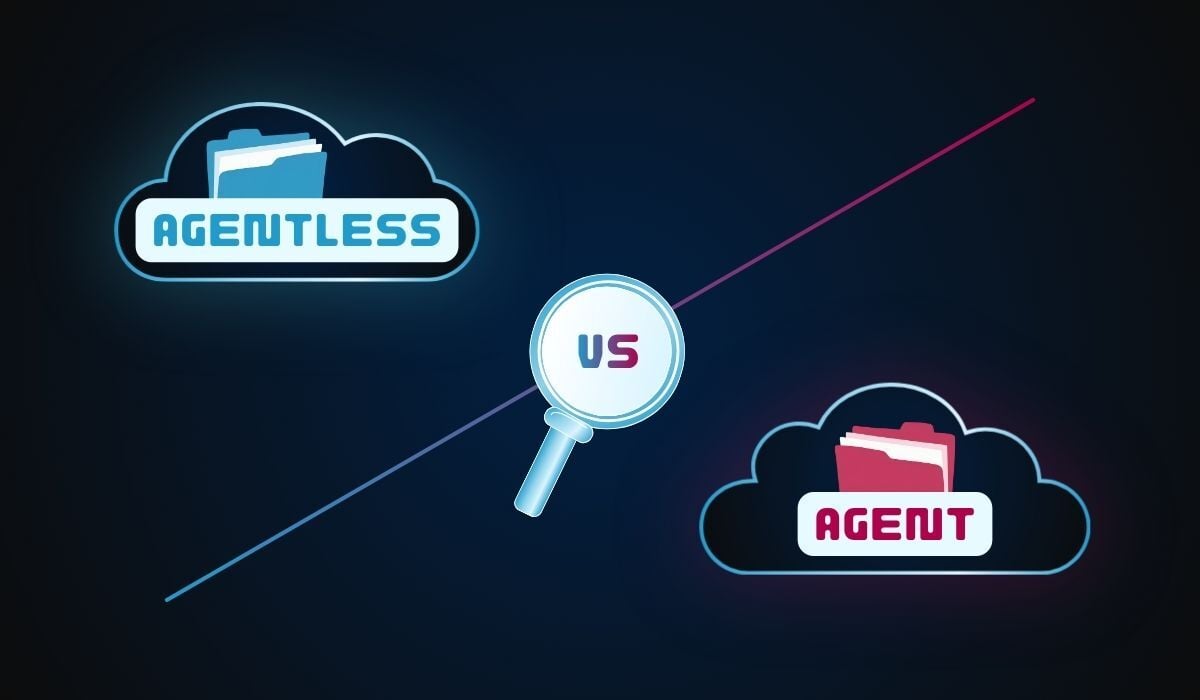
Quick answer: Agent-based file integrity monitoring (FIM) lives on every device, and tracks file changes in real time, giving you stronger visibility at the cost of having more to set up. Agentless FIM checks in remotely on a schedule, so it's lighter to deploy but leaves gaps between scans. If security depth is the priority, agent-based is the stronger choice. If you're running a lean team and mainly need to meet compliance requirements without a heavy lift, agentless can absolutely get the job done.
Once attackers get in, they don't waste time. The 2026 Verizon Data Breach Investigations Report found a median dwell time of just 4.3 days from initial access to ransomware deployment. File integrity monitoring exists to shrink that window, catching unauthorized changes before they turn into a full-blown breach.
This blog breaks down the two main types of FIM, agentless and agent-based, along with the pros and cons of each, so you can determine which one fits your compliance and risk mitigation needs.
What is File Integrity Monitoring (FIM)?
FIM tracks changes to your critical files, configurations, and systems, and then flags anything unexpected. It’s a requirement for standards like PCI-DSS, HIPAA, and SOX, and a foundational layer of protection well beyond the compliance checkbox.
Agent-Based vs Agentless FIM: The Actual Difference
"Agent" refers to whether monitoring software is installed on the device itself.
The primary security difference between these two types of file integrity monitoring software is how often files are "polled" or scanned for changes:
- Agent-based file integrity monitoring installs directly on every monitored device, capturing activity in real time regardless of how or where that device connects
- Agentless file integrity monitoring runs from a central gateway and checks devices remotely, with no local install required
While some agentless solutions allow administrative users to designate the period between file scans, others do not.
|
Agent-Based FIM |
Agentless FIM |
|
|
Detection speed |
Real-time |
Scheduled intervals (daily, weekly, vendor-dependent) |
|
Coverage |
Every connected device, including remote and mobile |
Whatever the gateway can reach |
|
Installation |
Required on every device |
Centralized, no local install |
|
Resource use |
Modest CPU/RAM per device |
Minimal |
|
Best for |
High-security or heavily virtualized environments |
Lean teams focused on baseline compliance |
Agent-Based FIM: Pros & Cons
Pros
- Detects and logs changes in real time, not just at the next scheduled scan.
- Captures all network-connected devices, including remotely connected devices.
- Provides a full picture of processes, operating systems, hardware, files, and connected devices.
- Allows administrators to take immediate risk mitigation actions, such as ending a suspicious session.
- Can cache activity locally and sync later if a device loses VPN or network activity.
Cons
- Requires installation on every monitored device, which varies in complexity by vendor
- Some RAM and CPU processing requirements.
- Can involve lower ongoing maintenance and a steeper learning curve than agentless options, depending on the vendor.
Agentless FIM: Pros & Cons
Pros
- Adds no additional RAM or CPU load on monitored devices.
- Often has lower installation requirements and resource requirements, depending on the vendor.
- Generally faster and simpler to deploy and maintain
- Requires fewer staff hours and less budget to implement.
Cons
- Doesn’t detect changes in real time, leaving a gap between scans where issues go unnoticed.
- Some vendors don’t allow adjustment of scan frequency.
- If the scans aren’t at least weekly, PCI-DSS compliance may be at risk.
- Does not capture local user activity, local processes, and other details.
- May not meaningfully monitor custom applications or encrypted traffic.
- Requires solid knowledge of network routing and custom configuration to capture useful data.
How to Choose: Six Questions Worth Asking
Choosing between these two options requires organizations to understand the contemporary threat landscape and how their networks introduce or eliminate vulnerabilities. Based on this assessment, you can identify the option that provides an acceptable threshold of protection. The following factors may be important to take into consideration:
1. How virtualized is your environment?
Agentless solutions are often less effective the more virtual servers you run, since it depends on remote polling. If your infrastructure is highly virtualized, monitoring all connected devices with an agent-based option may be more effective.
2. Do you want to meet the compliance bar or clear it comfortably?
PCI-DSS allows up to a week between agentless scans, which is a full week malware can go undetected in your network. If “compliant” and “sufficiently secure” don’t feel like the same thing to you, that’s worth weighing.
3. Can you grant external privileged access?
Agentless software requires organizations to provide external access to critical systems, which policy may restrict or require extensive custom configuration.
4. How much nuance do you need in reporting?
Not all changes to critical files are negative. Some changes are routine, some are necessary, some genuinely risky. Agent-based tools tend to be better at surfacing which is which, rather than leaving that sorting to you.
5. How stretched are your IT resources?
If your team is already at capacity, agentless FIM’s lighter setup and maintenance can be the more practical choice, even where agent-based offers more on paper.
6. Are you looking to grow your security program over time?
Agent-based solutions can grow with your information security program. For companies looking to become more involved in active monitoring and response, an agent-based program can offer broader functionality and more in-depth reporting on the "quality" of changes to critical files.
So, Which is Better: Agentless or Agent-Based?
There’s no universal winner here, only what’s right for your organization. Highly virtualized, high-security environments tend to benefit most from agent-based monitoring’s real-time detection. Leaner teams focused on meeting compliance requirements efficiently may find agentless FIM does the job well.
CimTrak is our agent-based recommendation, built to fully resolve negative changes to critical files, not just flag them. Beyond FIM, it also covers configuration management, vulnerability management, and compliance reporting, so it can serve as an even broader piece of your security stack. Schedule a demo or download our Definitive Guide to File Integrity Monitoring to see it in action.
FAQs: Agent-Based vs Agentless FIM
Does agent-based FIM slow down my systems?
It uses some CPU and RAM per device, but on modern hardware, the impact is typically minimal considering the added visibility. Tools like CimTrak are built to run efficiently in the background, so organizations don’t experience a meaningful performance hit.
Is agentless FIM PCI compliant?
Yes, as long as scans occur at least weekly. Less frequent scanning puts PCI-DSS compliance at risk.
Can I use both agent-based and agentless FIM together?
Actually, yes. Many organizations apply agent-based monitoring to critical, high-risk systems and agentless monitoring to lower-priority assets to balance security and cost. CimTrak supports this kind of layered approach as part of a broader security stack.
Is agentless FIM easier to set up than agent-based FIM?
Generally, yes. Agentless FIM doesn’t require installing software on every device, so initial deployment tends to be faster, though it typically requires more network configuration upfront.
Which is more secure, agent-based or agentless FIM?
Agent-based FIM is generally considered more secure, since it detects changes in real time and captures local activity that agentless tools can miss. CimTrak, for example, goes a step further by not just detecting unauthorized changes but resolving them automatically.
To learn more about this, check out the CimTrak Technical Summary.
.png?width=80&height=80&name=Lauren%20Yacono%20-%20Circle%20Greyscale%20(1).png)
August 13, 2026
Try CimTrak for Free
Get your Free 14-day trial of CimTrak
Just let us know what capabilities you want to test out, and we'll set up a trial in your environment.