In our previous post, we covered what the Cyber Resilience Act (CRA) is, who it applies to, and when its deadlines arrive. In this post, we’re going over the technical breakdown of what the law requires of a product and the people who make it. Most of these requirements are found in Annex I, the part of the regulation that lists the essential cybersecurity requirements. It’s, thankfully, a short list, and it’s the part your engineering team will care about the most.
What Do the CRA’s Technical Requirements Cover?
Annex I has two parts. Part I covers the security of the product itself, while Part II covers how the manufacturer handles vulnerabilities after release.
A cybersecurity risk assessment ties these two together. It determines how the requirements apply to a given product, and it must be documented and updated throughout the product’s support period. If a requirement doesn’t apply, the manufacturer needs to explain why in its technical documentation.
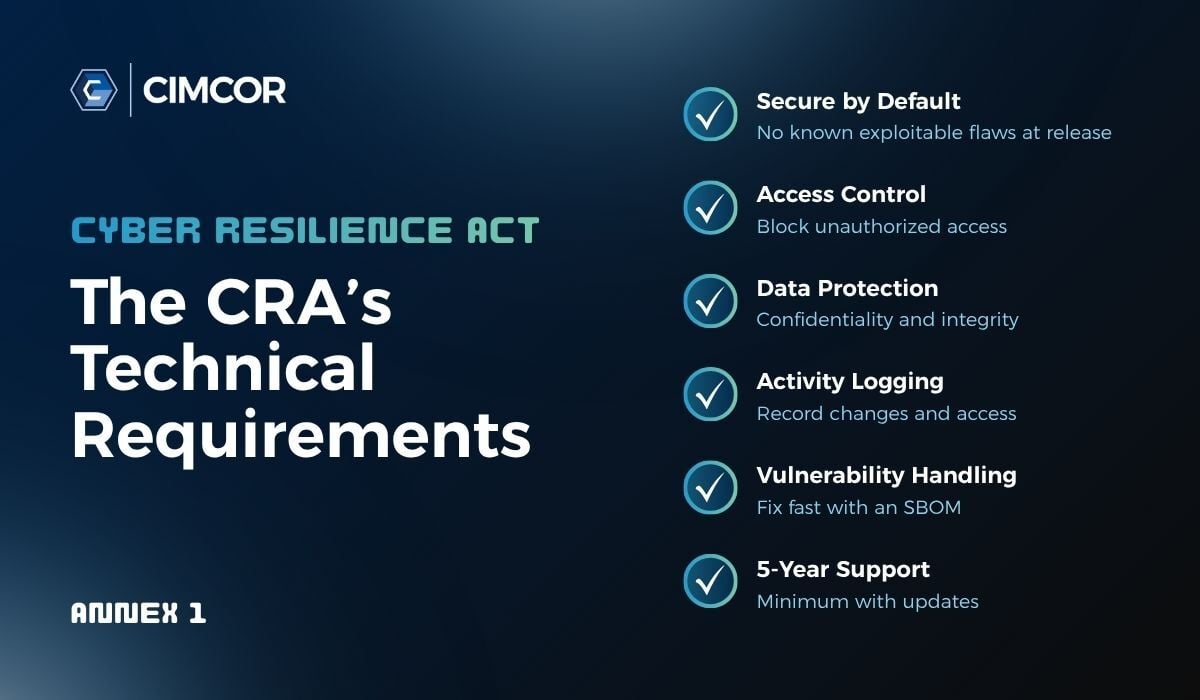
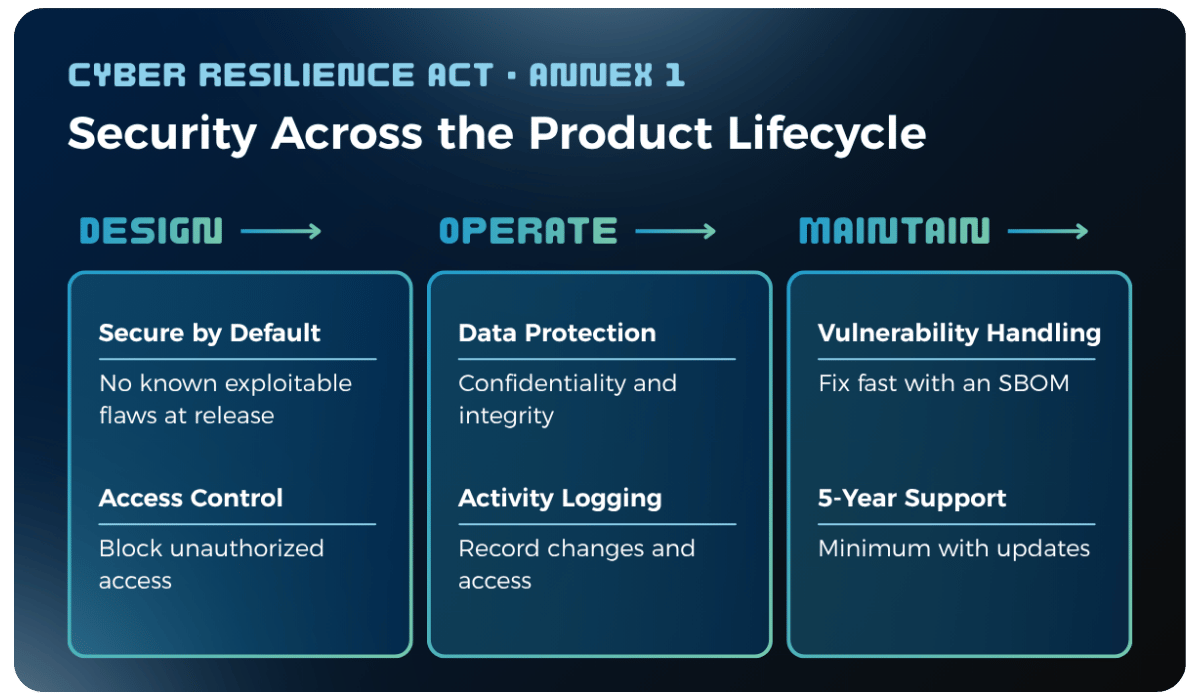
What Security Features Must Products Have? (Annex I, Part I)
Part I lists thirteen security properties:
|
Area |
Annex I Points |
What the CRA Requires |
|
Secure Starting Point |
(a), (b) |
No known exploitable vulnerabilities at release, and a secure-by-default configuration, including the ability to reset the product to its original state. |
|
Security Updates |
(c) |
Vulnerabilities can be fixed through updates, with automatic updates enabled by default, a clear opt-out, update notifications, and the option to postpone. |
|
Access Control |
(d) |
Protection from unauthorized access through measures such as authentication and identity or access management, with reporting on possible unauthorized access. |
|
Data Protection |
(e), (f), (g) |
Confidentiality of data (for example, encryption at rest and in transit), integrity of data, commands, programs, and configuration against unauthorized changes, with reporting on corruptions, and collection of only the data the product needs. |
|
Resilience |
(h), (i) |
Essential functions stay available, including after an incident and during denial-of-service attacks, without harming other devices or networks. |
|
Reduced Exposure |
(j), (k) |
A limited attack surface, meaning fewer ways to reach or attack the product, and mitigation techniques that reduce the impact of an incident. |
|
Visibility |
(l) |
Recording and monitoring of relevant internal activity, including access to or modification of data, services, or functions, with an opt-out for the user. |
|
Secure Removal |
(m) |
Users can securely and easily remove all data and settings permanently. |
Two of these deserve a closer look from anyone responsible for proving compliance: the integrity requirement and the activity-recording requirement. We’ll circle back to these later.
What Does the CRA Require for Vulnerability Handling? (Annex I, Part II)
Part II is all about what happens after the release. Manufacturers must:
- Identify and document vulnerabilities and components, including a software bill of materials (SBOM): a machine-readable inventory of the components inside a product, covering at least the top-level dependencies. Sharing the SBOM with users is optional.
- Fix vulnerabilities without delay, providing security updates separately from feature updates where technically feasible.
- Test and review the product’s security on a regular basis.
- Publicly disclose fixed vulnerabilities once an update is available, with limited room to delay when publication would create more risk than benefit.
- Maintain a coordinated vulnerability disclosure policy and a contact address for reports.
- Distribute updates securely and, in most cases, free of charge, with advisory information that tells users what action to take.
Manufacturers are also responsible for the components they use. They must exercise due diligence on third-party and open-source components, and report any vulnerabilities they find in those components to whoever maintains them.
How Long Must Manufacturers Support a Product?
The support period must reflect how long the product is expected to be in use, and under Article 13, it must be at least five years. The only exception is a product expected to be in use for less than five years, in which case the support period matches the expected use time. Manufacturers can’t simply declare a short support period and move on.
Security updates must remain available for at least ten years or for the remainder of the support period, whichever is longer. The end date of the support period, including the month and year, must be clearly stated at the time of purchase, and the reasoning behind the support period goes into the product’s technical documentation.
How Does File Integrity Monitoring Support These Requirements?
Several Annex I requirements come down to one question: can you show that a product and the systems used to build and maintain it haven’t been changed in ways nobody authorized? Three requirements stand out:
- Integrity: Protect data, commands, programs, and configuration from unauthorized modification, and report on corruption.
- Activity recording: Record and monitor access to or modification of data, services, and functions.
- Evidence: On request, show authorities how the product and the manufacturer’s processes meet the requirements.
File integrity monitoring compares files and configurations against a known-good baseline and records what changed and when. That record can help teams detect unauthorized modifications and give auditors evidence of how controls work in practice. It is one control among many, and it doesn’t satisfy the CRA on its own, but it speaks directly to requirements that are difficult to evidence any other way.
See it in action. Start a free trial of CimTrak or request a demo to see how file integrity monitoring works in your environment.