.png?width=120&height=120&name=Robert%20(1).png)
If you are running a strong EDR platform, you're doing something right. EDR is essential. It's great at detecting and responding to malicious activity: suspicious processes, behaviors, lateral movement, and indicators of compromise.
But here's the uncomfortable truth: EDR does not tell you, with certainty, whether your systems are still in a known and trusted state. EDR tells you what it can observe from an endpoint telemetry perspective. It does not establish and enforce an authoritative baseline for your environment across files, configurations, identities, and infrastructure.
That gap is exactly where integrity monitoring, done correctly, earns its place.
This post addresses the most common concerns we hear from security and operations teams:
- "I do not want another agent."
- "Another agent increases my attack surface."
- "We already have CrowdStrike (or fill-in-the-blank EDR), so we already have FIM."
- "FIM is just file change alerts and noise."
- "Baseline sounds like a lot of work."
Let's clear this up, cleanly and technically.
First: What File Integrity Monitoring Actually Means
Real FIM is not a feature checkbox. It's a methodology.
At its core, File Integrity Monitoring detects changes by comparing what exists right now against a known, trusted state. A reliable baseline is what makes that possible.
How do serious FIM solutions do that?
- They establish a baseline or "snapshot" of what should exist.
- They monitor for additions, deletions, and modifications.
- They validate change using cryptographic hashes, so you can prove a file changed and prove exactly what changed.
CimTrak works this way by design: it takes an initial snapshot, stores it securely in the CimTrak Master Repository to establish a known, trusted baseline, and then continuously compares any changes/modifications against that baseline.
This distinction matters.
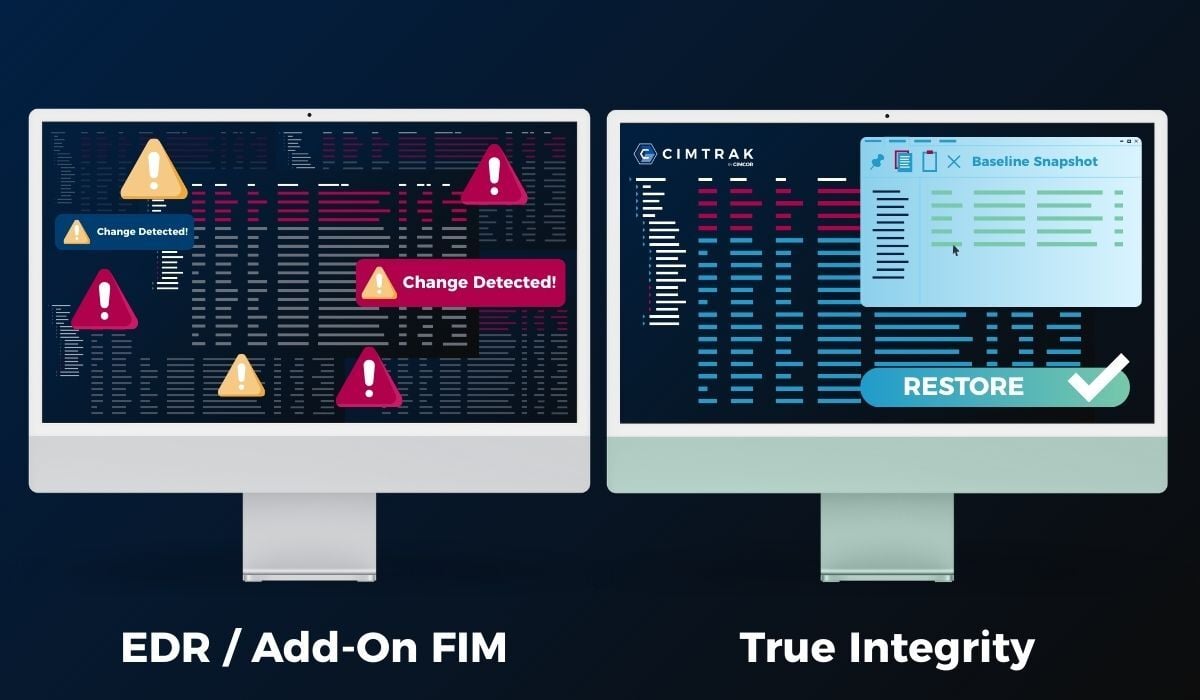
Being notified about a 'change' isn't especially useful on its own. Did it change from good to bad? Or from bad to good? Did it deviate from the 'authoritative baseline'? This also aligns with how System Integrity is defined in NIST 800-53 in the System Integrity (SI) section.
So when someone says, "We already have FIM in our EDR," the real question is:
Do you have a baseline you can trust and restore to, or do you just have file change alerts?
Those are NOT the same thing.
The Market Confusion: "File Change Monitoring" Is Being Sold as "FIM"
Many "FIM add-ons" inside endpoint tools are, in reality, just "file change monitoring".
That usually means:
- Watch a set of file paths
- Generate change events
- Forward those events to a console
That can be useful. However, it does not deliver integrity on its own.
Why? Because integrity is not the detection of change. Integrity is the ability to answer, quickly and reliably:
- What changed?
- Who changed it?
- How did it change?
- Was it expected or authorized?
- If it was not authorized, can we roll it back to the last known good state?
CimTrak provides deeper context around change (what, when, who, how, and by which process). It can also provide side-by-side comparisons to pinpoint what has changed within a file.
There is a difference between "noise" and "signals."
Why EDR Alone Still Leaves You Exposed
EDR is great at what it does, but it is not designed to be an enterprise-wide integrity authority.
Here are common, high-impact examples of what integrity monitoring catches that many teams struggle to operationalize through EDR alone.
1. Changes That Aren't "Malware-Like"
Attackers are increasingly using legitimate tools and administrative paths. They don't always need to drop obvious malware.
So the real questions become:
- Did local security policy change?
- Was a new local admin added?
- Did a service get added or modified?
- Did a registry key change weaken security?
- Was an unexpected program installed?
- Was a new user added to Active Directory?
- Did a critical port configuration change?
- Did your hypervisor settings change?
- Did your cloud configuration change?
- Did a network device configuration drift?
CimTrak monitors far more than files, including items like Windows Registry, installed software, services, drivers, local users and groups, local security policy, authorized ports, network devices, hypervisors, databases, domain controllers, cloud configurations, SCADA systems, any OT devices, and more.
These changes don't always look malicious, but they're still dangerous.
2. Blind Spots Beyond the Endpoint
Many EDR conversations stay focused on Windows endpoints. This is not where your risk stops.
CimTrak's coverage extends across servers, workstations, virtual machines, network devices, hypervisors, containers, cloud configurations, databases, directory services, and more. Additionally, CimTrak supports a wide range of platforms beyond Windows. CimTrak supports Windows, Linux, Solaris, macOS, HP-US, FreeBSD, and AIX, as well as a wide range of network devices and other assets within your infrastructure.
If your integrity monitoring is limited to "files on a Windows box," you still have major exposure in places attackers love to target: identity, virtualization, database, cloud, and infrastructure configuration.
Baseline is Not "Extra Work." Baseline is the Only Way to Prove Trust
A baseline is simply an authoritative picture of what is allowed to exist.
CimTrak's model is explicit:
- Establish baseline
- Detect deviations
- Alert and respond
- Optionally restore or prevent change
- Document and report
Without a baseline, you can detect events, but you cannot reliably enforce integrity.
A baseline is what turns integrity monitoring into resilience. When something breaks, you want more than an alert. You want a proven path back to a known good state.
That is integrity. Not alerts.
"Another Agent Increases My Attack Surface." Let's Address That.
This concern is valid as a principle. Not all agents are created equal.
The right way to evaluate this is to get specific about architecture and risk.
1. Attack Surface is About Exposure, Not Existence
Adding software can introduce risk if it:
- Opens inbound listening ports
- Expands privileged code paths without strong hardening
- Creates additional remote management endpoints
- Requires complex inbound firewall exceptions
- Adds fragile dependencies
CimTrak's architecture is designed around secure communications between components and a Master Repository that stores monitored items securely in compressed and encrypted form. CimTrak is also designed to be lightweight, minimizing its impact on CPU cycles and network bandwidth.
The practical takeaway is simple:
Do not evaluate "agent vs no agent." Evaluate what the agent exposes, what it listens to, how it communicates, and how it is secured.
2. Security Posture is Prevention, Detection, Response & Recovery
CimTrak provides multiple operational modes beyond logging, including restore mode (rollback) and deny rights mode (prevent changes by blocking access).
Those capabilities matter because they convert integrity monitoring from passive reporting into active control.
The Bigger Point: CimTrak Isn't "FIM." CimTrak Is System Integrity Assurance.
"FIM" is often treated as a checkbox. That's why teams get disappointed.
There is no integrity in detecting change alone. Integrity comes from the surrounding capabilities: context, reconciliation, prevention, rollback, and verification.
That is why we talk about System Integrity Assurance as a closed-loop process:
- Establish a trusted baseline
- Capture approved changes
- Detect and classify changes in real time
- Reconcile with change control with operational integration with ITSM systems such as ServiceNow, BMC Remedy, JIRA, and more
- Roll back or prevent unauthorized changes
- Prove it through reporting and evidence
This is fundamentally different than file change alerts.
A Simple Self-Assessment: Questions Your Team Should Be Able to Answer
If you want a fast way to cut through marketing language, use these questions:
- If a new local admin is added on a critical server, how fast will you know, and what evidence will you have?
- If a security policy changes, can you prove what changed, who did it, and how?
- If a critical hypervisor or network device configuration changes, how do you detect it and restore it?
- When a file changes, how do you distinguish routine patching from suspicious drift without drowning in noise?
- When something is wrong, can you quickly and confidently roll back to a known, trusted baseline?
If you cannot answer these with clarity, you likely do not have integrity monitoring.
You have alerts.
Why CimTrak Plus EDR Is the Modern Stack
EDR helps you detect and respond to malicious behavior.
CimTrak helps you prove and enforce the integrity of systems and infrastructure, and recover quickly when integrity breaks.
CimTrak also integrates with common enterprise systems so integrity events can become part of incident response, change control, and reporting workflows.
This isn't overlap. It's complementary coverage.
Bottom Line
If you want to reduce breach impact, downtime, and uncertainty, you need the ability to continuously verify integrity and respond decisively.
EDR helps you chase threats.
CimTrak helps you prove trust, detect drift, and recover fast when trust is broken.
Modern security programs don't choose between EDR and integrity assurance.
They use both.
.png?width=80&height=80&name=Robert%20(1).png)
Try CimTrak for Free
Get your Free 14-day trial of CimTrak
Just let us know what capabilities you want to test out, and we'll set up a trial in your environment.